
Two Forms of "Technology" Criticism: Cultural Pessimism Versus Materialism
By Lee Vinsel
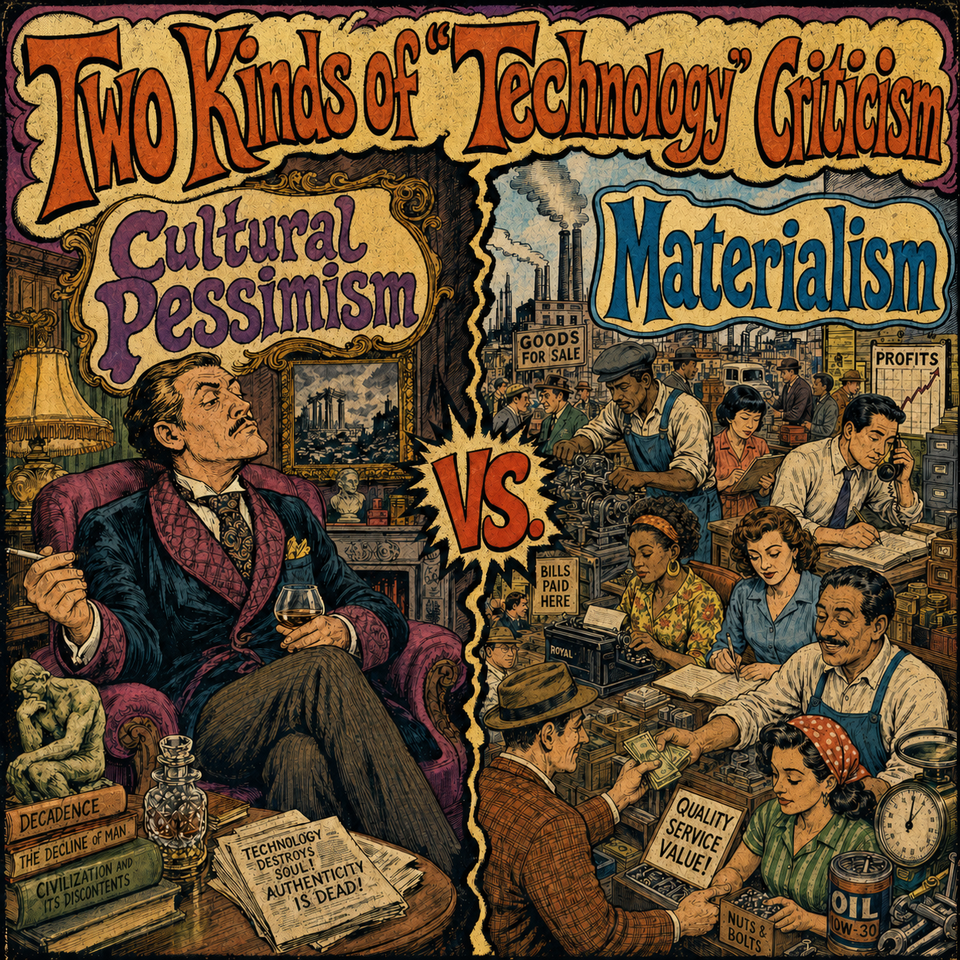
A while ago, I began jotting an email to my friend and mentor, Richard John, and quickly realized I was writing an essay I had wanted to do for years. Below, I outline two forms of "technology" criticism. One I think sucks and call Cultural Pessimist Technology Criticism (CPTC). The other is true, good, and beautiful. It's known as materialism.
I have decided to publish this essay as an open letter to Richard because that is how it began. I have been lucky to count him as a teacher for over twenty years. If you don't know him, Richard is a historian of American institutions, who often works at the intersection of histories of technology and business. After I got my BA in philosophy and was working at a psychiatric hospital in Chicago trying to figure out what the hell I was doing with my life, I became Richard's research assistant, doing little tasks that contributed to his award-winning book, Network Nation: Inventing American Telecommunications. Richard is a wild guy with a ranging curiosity and encyclopedic memory. He also, famously, happens to be a kind and generous man who takes great interest in fostering emerging scholars. Two of my all-time favorite YouTube videos involve him a) explaining how networks have changed the way historians think and b) calmly and patiently tearing Tim Wu's guts out in front of a live audience. You can hear my Peoples & Things interview with Richard, mostly focusing on his current book project, a history of anti-monopoly thinking in the United States, here.
It says something, I think, that an essay my soul has wanted to write for years finally began pouring out in conversation with Richard. I'm very grateful for him.
This post is long, so if you'd rather read it as a document, you can download it as a pdf here or as a word doc here.
Dear Richard,
We reached a point in our email correspondence where I needed to take a moment to think about what I was saying and double-check some things. That process has led to this essay.
I apologize for being too telegraphic in our email exchange. You are right that I was assuming things that largely come from my early training in French and German philosophy.
Let's remind ourselves where we were and how we got here: We had been talking about authors like Jacques Ellul, Theodor Adorno/Max Horkheimer, (late) Lewis Mumford, Neil Postman, Langdon Winner, David Noble, Wendell Berry, Paul Kingsnorth, and we might add Alan Jacobs, Luke Fernandez, Nicholas Carr, Michael Sacasas, and so on - critics of something they call "technology" or something close to that.
I describe such figures as purveyors of Cultural Pessimist Technology Criticism (CPTC) because my sense is that their thinking is rooted in a specific late-19th and early-20th century German tradition - or zeitgeist – called Kulturpessimissmus, or cultural pessimism. Oliver Bennett defines the intellectual strand like this, “Cultural pessimism arises with the conviction that the culture of a nation, a civilization, or humanity itself is in an irreversible process of decline.”
I am interested in versions of cultural pessimism that blame cultural and social decline on technology or industry. My sense is that CPTC authors were influenced, directly or indirectly, by central German cultural pessimist thinkers, like Oswald Spengler, Ernst Jünger, and Carl Schmitt, who made this intellectual move. (Important to emphasize: I'm not talking about the stupid and childish distinction between "optimism" and "pessimism" that fills much writing about technology today; I’m referring to a particular intellectual lineage coming from a specific place and time.)
I found myself saying to you that CPTC thinkers assert that a big problem in society is that people worship "technology"/instrumental reason/technics/etc. and that such criticisms amount to an accusation of idolatry. (You wondered what I meant by that.) The world would be a better place, such critics assert, if only some people, especially powerful ones ("Big Tech" oligarchs, "tech bros," whatever) but really almost all of us, didn't put "technology" on an altar where something more holy belongs (God, goodness, justice, etc.). Put another way: Instrumental reason is a key part of human being, but it somehow slipped its appropriate bounds. Why did it escape? Because we have come to worship it in a way that is deeply unhealthy.
In what follows, I want to do two things: First, I talk through my current understanding of the historical background and development of this idolatry critique. My picture here is sketchier than I would like it to be. But right now I have to write a different book, which is related to these themes as I'll explain below but isn't the intellectual history I'm gesturing towards here. So, I think of this post as a set of historical hypotheses for future empirical exploration, including with friends like you, Eric Hounshell, Erica Robles-Anderson, danah boyd, and Chad Wellmon.
Second, I will explain why I think CPTC is a false intellectual path that has become a giant distraction from deeper, bigger things actually ailing societies around the globe. We have a better option available for our work: materialism, a term I'll explain as we go along.
These reflections play into historical analysis in a few ways. First, if we are writing about people who are influenced by CPTC ideas, we will need to interpret and make sense of where those ideas came from and how holding them affected action. But I think there’s also something bigger at stake here for humanistic and social scientific inquiry into the material dimensions of human life and society. We should not abide CPTC in our own thinking because it is a position full of errors. While it may sound at times like I think CPTC is morally or politically wrong . . . well, true enough! and importantly so . . . . But what really interests me here is that CPTC is a lousy, unclear, unsophisticated perspective on the world that blinds us to a deeper, more rigorous, more robust understanding of society.
Finally, not all thinking needs to be focused on criticism, though being self-critical is a trait of most excellent thought. Some fields I work in have become so focused on critique they aren't doing enough basic descriptive work and, as a result, there are loads of important technology topics we know very little about. But if we ARE going to criticize existing social orders, CPTC isn't the way to do it; materialism is. Or so I'll argue.
We should begin with the notion of "instrumental reason." Political theorist Lillian Cicerchia's article, "Making Sense of Critical Theory's Economic Gap," is helpful for thinking about the history of this concept. It's noteworthy that Cicerchia writes her article to explain how the notion of the economy dropped out of critical theory over the last several decades. You and I have long discussed how many fields moved away from political economy during that same period, and this move is a hallmark of CPTC writing: It has a naive take on the economic or neglects it altogether. Indeed, I can go into this another time, but many contemporary critics of "solutionism" appear to have zero understanding of political economy - of how states, markets, industries, firms, classes, and customers work.
Cicerchia traces the notion of “instrumental reason” to Max Weber who defined it in opposition to other forms of thinking. Weber wrote that the
instrumentally rational (zweckrational) is determined by expectations as to the behavior of objects in the environment and of other human beings; these expectations are used as "conditions" or "means" for the attainment of the actor's own rationally pursued and calculated ends
More simply, instrumental rationality is how we reason about means to achieve desired ends.
Weber, Cicerchia writes, was intervening in an ongoing debate in German economics involving Otto Neurath and Ludwig Mises, which had to do with whether "economy" and "society" were separate "spheres." (Dividing human reality up into "spheres" was a major obsession during that period, as John Levi Martin nicely shows in his book, The True, The Good, and The Beautiful.) Weber sided with Mises in arguing that that economy and society were separate spheres. Instrumental rationality was a core aspect of the economic sphere that menaced other parts of culture. As Cicerchia explains, Weber worried that the process of economic rationalization "may become antisocial, penetrating too deeply into noneconomic terrain, like the family." (4) This dichotomy and thought form – that economy and society were separate, and that the former threatened the latter - became very influential and was repeated again and again over the course of the 20th century, including, for example, in the later work of 2nd Generation Frankfurt Schooler Jürgen Habermas.
This separate spheres thing was a terrible intellectual move. Feminists, including Nancy Fraser, criticized Habermas and others who repeated the picture for its sexism. As scholars of women’s history and theorists of social reproduction have shown time and again, the domestic sphere isn’t free from instrumental rationality. QUITE THE OPPOSITE! It’s just that the work of the home was traditionally women’s work that fell outside of male theorists' understandings. The boys just didn’t see it. They didn't see it because they weren't looking. Shame on them. Cicerchia herself attacks the spheres division from a philosophical pragmatist perspective. We are all always involved in practical activity from the moment we roll out of bed (and, of course, beds, mattresses, pillows, and linens are themselves the product of instrumental reason and action with long periods of slow innovation and change) until we, if we are good little boys and girls, brush our teeth with a tool called a toothbrush, before crawling back into the sack.

(You and I sometimes chat about meditation. In my experience, a distinction between DOING and BEING can be useful for beginning meditators. It encourages them to stop their everyday activities, sit on their asses, and watch what’s going on around and in them, especially in their minds and, most important, in the fields of their awarenesses. But when you go deep enough with meditation, you realize this distinction is only a heuristic. It’s a handy lie. Ultimately the movement of the entire universe is just being doing doing.)
Scholars disagree about whether Weber himself belonged to the rising tradition of Kulturpessimissmus. My buddy, Eric Hounshell, thinks he was. But the important thing is that Weber articulated his idea in the context of the intense period of industrial and technological transformations, especially in the United States and Germany, that's sometimes referred to by the lame term, the Second Industrial Revolution. Clearly, *MANY* people were concerned at that time and wrote about changes happening around them.
Jeffrey Herf, Eric Schatzberg, and Adelheid Voskuhl have shown that many early German thinkers about technology or what they called Technik (often translated into English as technic) were engineers. But it is striking how quickly the critique of instrumental rationality and technology became the purview of folks in the humanities.
Writer Oswald Spengler is the clearest exemplar of how anti-technology and anti-industrial instincts took hold in humanities-centered Kulturpessimissmus in the first decades of the 20th century. Spengler's The Decline of the West, published between 1918 and 1922, pictured cultures as organisms that went through dependable cycles of growth and decline. The book took the world of ideas by storm not only in Germany but in many other nations, including the United States.
In 1931, Spengler published Man and Technics: A Contribution to a Philosophy of Life. In many ways, the book was a pithier restatement of Decline of the West, but in the decade between the two publications, Spengler had clearly come to believe that technology and industry were, or at least would be, the chief causes of civilizational decline. (Among other things, he argued that one big problem is that people in "the coloured world" outside Europe were going to get ahold of Western technologies and then use them to attack and destroy the West, which, I don't know, call me crazy, strikes me as at least kinda racist.)
Man and Technics contained a number of intellectual moves, themes, and vibes that became hallmarks of CPTC thinking, so it's worth looking at briefly. In his preface to the 2015 Arktos Media edition of the book, Lars Holger Holm writes,
Before arriving at his final definition of industrial technology and its ominous historical mission–more than implying that, in its grip, we are all children of Sisyphus–Spengler opens his argument by demonstrating that what we today call technology, with all its specialized and machine-based applications, is a development of something that is common to all living beings on the planet: technique.
Spengler begins his book by examining how both human and non-human animals share in "technique," which in many ways reprises Weber's instrumental reason.
Later, Spengler argues, through a rhetoric of racial science common at the time, that "Faustian, Western cultures" have made technique slip its traditional bounds and endanger civilization itself:
There are, once more true beasts of prey whose inner forces struggle fruitlessly to break the superiority of thought, of organized artificial living, over the blood, to turn these into servants . . . A will to power which laughs at all bounds of time and space, which indeed regards infinity as its specific target, subjects whole continents to itself, eventually embraces the world in the network of its forms of communications and intercourse, and transforms it by the force of its practical energy and the gigantic powers of its technical processes. (63)
The end result as Spengler writes, "The Lord of the World is becoming the Slave of the Machine, which is forcing him - forcing us all, whether we are aware of it or not - to follow its course. The victor, fallen, is dragged to death by the raging team."
We might pause for a moment to note that, maybe minus the race science, this is exactly the kind of shit that CPTC writers today say about technologists and, for example, digital technology executives and the systems they build. That's because CPTC writers thoughtlessly and endlessly replay scripts from this earlier era, typically without realizing what they are doing. A most delicious irony: While CPTC writers today often like to cast themselves as being on the political left, they are in fact drawing on ideas first put forward by conservatives and literal Nazis. Hey, COOL!
We also might wonder why, the rise of Nazism and the horrors of World War II notwithstanding, the history of rich Western and other nations on the planet has not been one of constant decline since Spengler published his book. It's because his analysis was superficial, not the stuff of serious humanistic and social scientific inquiry. To be clear, having negative reactions to many changes arising during the period of the Second Industrial Revolution was perfectly understandable! There were many acute problems.
It's just that CPTC thinkers like Spengler didn't go deep enough in their analysis. They blamed problems on technological change and the forms of reason that gave rise to it, rather than looking at the more fundamental shifts in institutions, social structures, and incentives that drove these changes. As a result, Spengler and his ilk also couldn't see or understand the social forces that would give rise to reform, to regulation, and to the many forms of global material progress we have seen over the last 100 years, for all the problems we have also created.
I'll say more about this below, but it's worth marveling over one point for a moment: After more than 100 years of existence, there still isn't a single empirically-serious CPTC work marked by the forms of evidence we expect of academic thought. Not a single one! It's incredible when you think about it. And it's because CPTC is a tradition carried on by people who are not interested in studying and learning about the world, which requires work, but who rather prefer to judge it, which one can do with one's soft ass firmly planted in an armchair.
Spengler was just that kind of guy. He was deeply influenced by Friedrich Nietzsche, and he followed Nietzsche's habit of writing wild, non-empirical historical narratives. His writing, at times, approached something like political theology, which is not open to any kind of validation through research. As Holm puts it, "By describing history as the result of a hidden yet active destiny, Spengler posited an invisible spiritual agent behind the palpable patterns of civilization." (14)
In this way, Spengler really wrote more as a poet or artist fitting a specific aesthetic bent of his time. As Holm notes, Spengler's writing "bears the hallmark of an Expressionism characteristic of such diverse creations as the Metropolis of Fritz Lang, the sordid darkness of Franz Kafka's The Castle, the erotic angst of Alban Berg's opera Lulu, and the pent-up fury in a stormy seascape by Emil Nolde." (10) CPTC writers often complain that they are falsely accused of empty-headed romanticism, but they kid themselves. Just like Spengler, they are quite literally repeating anti-technological tropes of 19th and 20th century romantic traditions, as books like Humphrey Jennings Pandæmonium, 1660-1886: The Coming of the Machine as Seen by Contemporary Observers and Michael Löwy and Robert Sayre's Romanticism Against the Tide of Modernity make clear. CPTC writers aren't intellectually serious; they are emo.
Finally, Spengler's vision was unremittingly nostalgic. That's simply a logical consequence of the picture. Culture was falling from a better time. And this nostalgia necessarily became a hallmark of CPTC thinking more generally. An ever-backwards-looking nostalgia, full of unrealistic images of better times and pinnacle Golden Ages, is baked right into the thought form.
As we have discussed, central early American writers about "technology," including Charles Beard and Lewis Mumford, were not only enthusiastic readers of Spengler but also reviewers of his books. Indeed, a variety of things, including some passages in Eric Schatzberg's Technology: Critical History of a Concept, suggest that Beard and Mumford may have gotten their ideas of technology and "technics" from this German theorist of cultural decline.
Now, you have said that your own research is finding that Americans, including but not limited to Beard and Mumford, may have been influenced by German ideas about technology, but they were . . . well, too optimistic to go for the darker sides of the German vision, which, after all, may have largely stemmed from painful sauerkraut-induced abdominal distension, a known regional health issue. As a hypothesis, that sounds plausible to me, and I can't wait to see what you write about this.
But I think we should note how, even in his early writings on technology, Mumford was already deeply influenced by Kulturpessimissmus. In his 1934 book, Technics and Civilization (again, note his use of potentially-Spenglerian language), Mumford examined the rise of three technological ages, which he called the Eotechnic, the Paleotechnic, and the Neotechnic. Mumford idealized the earliest, premodern, agrarian Eotechnic phase, the world of "water and wood," and claimed that people during that period strove for harmony with each other and nature.
Mumford clearly saw the second phase, the Paleotechnic, the world of coal, steam, iron, and industrial technologies, as a fall. He described the Paleotechnic as "an upthrust into barbarism, aided by the very forces and interests which originally had been directed toward the conquest of the environment and the perfection of human nature." Mumford's romantic nostalgia for the Eotechnic versus what he saw as the "Dark Satanic Mills" blackness of the Paleotechnic probably comes out most clearly and lyrically in the 1939 film, The City, which was based on his writings.
But in this early moment, Mumford still had hope, as both Technics and Civilization and The City make clear. He argued that the emerging technological phase, the Neotechnic, the world of electricity and steel, when combined with the urban planning of green ring garden suburbs, might take culture away from the wickedness of the Paleotechnic. Later, as we'll see, Mumford's hopes disappeared.
As I said earlier, scholars have described how a lot of early German writing about technology came from engineers, but as Spengler, Beard, Mumford, and others show us, by the 1930s, CPTC writings about technology and instrumental rationality were primarily the domain of people squarely in the humanities. For example, from the 1930s onwards, philosophers like Martin Heidegger, Theodor Adorno, Max Horkheimer, and others penned works that replayed tropes laid down by Spengler and other cultural pessimists.
For a long time, this shift from engineers to humanists puzzled me. But then I read Paul Reitter and Chad Wellmon’s wonderful book, Permanent Crisis: The Humanities in a Disenchanted Age. Reitter and Wellmon show that pearl-clutching worries about being at risk and under attack was baked into the identity of the humanities from the very moment they professionalized in Germany around 1800. (There are so many lovely, beautiful, darkly hilarious jokes to be had here, but I’m going to keep moving, much as it pains me, and, boy, does it ever.)
Over time, the humanities came to define themselves in opposition to the world of practical affairs, to industry, to engineering and science, and to technology (which is one reason why so many people working in the humanities clearly don't understand how businesses and industries work, to say nothing of mathematics, science, and technology).
Reitter and Wellmon write,
In contrast to prior traditions of humanist knowledge, the modern humanities are consistently cast as a particular project to countervail against specific historical forces and problems that threaten the human. The modern humanities address not disordered desires, unruly passions, or the presence of evil but historical changes: industrialization, new technologies, natural science, and capitalism.
This structural definition of the humanities in opposition to the world of work means that humanities-rooted CPTC thinkers are always taking part in what Pierre Bourdieu and Bruno Latour taught us to see as a politics of purity. In books like Pascalian Meditations, Bourdieu especially warned scholars against reifying, taking for granted, and uncritically thinking from the perspective of scholars not involved in practical affairs. (Famously, both school and scholar have their etymological roots in skhole, the Greek word for free time or leisure.) Too often, we pride ourselves, even parade, about our clean hands, and we would do well to remind ourselves of Hegel's warnings about beautiful souls.
I imagine some would argue that these politics of purity are largely an extension of another older and famous value hierarchy that runs through Western thought at least back to the Ancient Greeks: the division between the head and the hand, that is, the esteemed few who possessed leisure and the free time to philosophize and theorize versus those others (often slaves) who did the menial physical labor elites relied on. It could be that, as something like the knowledge economy and its attendant professional-managerial class emerged and expanded beginning in the late-19th century, those who wished to keep themselves pure had to draw a new line between those who used their minds to do (dirty) work and those who engaged in thinking largely for its own sake (or, more practically, as William Clark might have put it in his lovely book, Academic Charisma and the Origins of the Research University, to impress others with their intellectual virtuosity).
Now, humanists have had different definitions of what their own special powers of thinking are that stand in opposition to instrumental rationality and technology. But one of the most common is the claim that the humanities and the humanistic social sciences possess something special called being critical. To put it a bit cartoonishly for a moment: You engineers, technologists, and business people worship impure instrumental rationality (see also, "solutionism") in your Temple of Mammon, while we humanists possess good critical thinking, which, if abided by our students, politicians, and other important people, will save the world.
These are the vanities of the humanities.
A breath: Realizing all of this is why, for a while, I was angered, deeply saddened, even depressed, but not really surprised by unthinking reactionary takes on Generative AI coming out of the humanities over the past few years. We claim that we aren't anti-technology, but lots of us obviously are. Indeed, our fields train us to be this way. This stance becomes what Bourdieu called our habitus, our unthinking, instinctual aesthetic reaction to things we perceive. You can see how our vibes are running the show in lots of ways, but most of all when people unthinkingly repeat misinformation - like, say, overstating the environmental and electricity price impacts of data centers - that, as some nerds like to put it, confirms their priors. There's a lot of that going on these days. I hope to write more about this later this summer in a post I'll probably call "How the Academic Reaction to Generative AI Broke Me and Set Me Free."
As we've discussed, Kulturpessimissmus appears to have not greatly influenced American thinking before World War II, but then CPTC writing takes off after the war, including eventually in academia. I'd like to briefly consider how this might have happened. It's something I hope to explore more down the road.
In conversations, several people have told me they think the experiences of World War II itself led to CPTC becoming much more widespread, including in the United States. You have told me that one explanation for Mumford's turn away from the hopes of Neotechnics to a thoroughgoing pessimism, including his writings on the "Megamachine," was his reaction to Hiroshima and Nagasaki. Others have made similar arguments about German writers, including members of the Frankfurt School. All of this sounds plausible to me. But while the horrors of World War II might explain why so many seemingly-smart figures fell into the bucket of thinking errors that is CPTC, it does not excuse them.
In the 1950s and 1960s, CPTC arguments became popular in whole new ways, especially via the writings of Jacques Ellul, Frankfurt Schooler Herbert Marcuse, and Mumford, who, Schatzberg writes in Technology, "were united in their vision of technology as a system of instrumental reason that subordinated ends to means." Schatzberg goes on, "There was very little novel in any of these critiques . . . Ellul, Mumford, and Marcuse were elitist humanist intellectuals, deeply hostile to popular culture."
There was nothing novel in these critiques because they all were reprises of the earlier cultural pessimist thinking we have seen. These authors were "elitist humanist intellectuals, deeply hostile to popular culture" because they raged at the world around them from a position deeply invested in a politics of purity. They especially took aim at new media technologies, as we see in writings on "the culture industry" and Neil Postman's screeds against televisions and computers. They were fuggin' snobs. Duh.
In "Technology, Reification, and Romanticism," a fascinating 1977 review essay covering three books, including Langdon Winner's Autonomous Technology: Technics-Out-of-Control as a Theme in Political Thought, Jeffrey Herf notes that leftist critics in the 1960s and 1970s had pointed out that Herbert Marcuse's critiques of technology echoed conservatives like Spengler and Ernst Jünger and Nazis like Carl Schmitt. Herf argues that similarities between Marcuse and these conservatives are only superficial, which is partly true, but I think he lets Marcuse off the hook way too easily. What Marcuse never made clear - and indeed no one has ever really established - is why thinkers interested in justice and the diminishment of suffering in the world need the concept of "instrumental reason" or "technology," if that term is defined as it has been above. (Schatzberg points out that Karl Marx had no concept of "technology" and apparently didn't need one. Capital was enough. I will return to this thought below.)
My sense is the real vector by which CPTC ended up in American academic thought, though, is via members of the 1960s youth movement known as the New Left. Those kids were reading Ellul, Marcuse, and Mumford, and some of dem youngins later became professors. Boomers. It's always the Boomers. I'll be exploring this more in an essay called, "Notes on Boomer STS," I hope to post in a few weeks.
Recently, both Casey Eilbert in her dissertation, a history of the idea of "bureaucracy" and its critics, and Ben Waterhouse in his essay "Big Brother and the Holding Company" have shown us how the hippies of the New Left turned hard against bureaucracy or what they called "technocracy." In his 1969 book, The Making of a Counterculture: Reflections on Technocratic Society and Its Youthful Opposition, New Left critic Theodore Roszak drew explicitly on Marcuse and railed against "objectivity" and forms of instrumental rationality, writing, "The technocracy increases and consolidates its power . . . as a transpolitical phenomenon following the dictates of industrial efficiency, rationality, and necessity."
As I said, I will be writing more about this soon, but from the New Left, it's a short step, often made by single individuals, into academic thought, which is why so many writers popular in fields like Science and Technology Studies, such as Langdon Winner, the co-production school, and James Scott, bear hallmarks of CPTC. You can smell it on 'em, actually - sniff, sniff.
From these and other vectors, a gyre widens. The end result is that there are varieties of CPTC all over our contemporary landscape in both popular culture and academia, including in various critiques of "solutionism."
(I might write more about this later, but for now I'll just note in passing that folks of this CPTC ilk tend to be strangely obsessed with the idea that they need to teach undergraduate STEM students ethics. Probably several things lead to this desire, but one of them is that these folks see instrumental reason as a threat. No doubt we know of lots of examples where experts have hurt people, but these folks never bother to establish the relative scale and scope of these harms - that is, how much human suffering experts are causing relative to other causes. My hunch is that these folks are considerably overplaying their cards. In the most extreme cases, undergraduate classes of this persuasion feature one week after another focused on stories about STEM experts doing bad things, and one would not be totally unreasonable to wonder, Is the real goal of these courses to make these young people ashamed of the professions they are entering?)
Ok, that is the historical picture I am interested in exploring. But by this point, you might be asking, Well, if CPTC is bad, what is better? Or even, what other alternative is on offer?
My answer is materialism, by which I largely but not exclusively mean traditions of political economy. These traditions certainly include Marxism and what we can learn from it, but also go way beyond it to other schools of social and economic thought. The term materialism has multiple important meanings, but here I want to emphasize two aspects:
First, materialist analyses start by examining physical reality and how it is socially organized, including basic questions like how things get made and grown, how people eat, where they sleep at night, and who is doing what kinds of work. And they often take interest in problems in these arrangements - that is the critical bit. Most centrally, materialist analysts ask, What, materially, is causing human suffering here? (For sure, non-human suffering and environmental damage matter too. But it's just a plain fact, good or bad, that the central question has been about human suffering.) As I put it elsewhere, instead of chasing after something called "technology," material analyses start where the pain is.
The second point has to do with hermeneutics, or the theory of interpretation: To start at least, materialist analyses assume that people's thoughts and actions largely arise from their interests in the world, which are both shaped by and articulate plans for the state of material reality. Nothing is more obvious than this: Humans take and have interests in the world. At one point, it became fashionable, including in some areas of technology studies, to argue that analysts simply imputed interests to people they were studying without evidence, almost mystically. But that critique is an outrageously superficial position that was probably only possible in the moment of High Postmodern Stupidity of the 1980s and 90s when people seemingly just said whatever they liked.
In "On the Other Side of Values," John Levi Martin and Alessandra Lembo, drawing on psychology, sociology, and other fields, show that we have a perfectly defensible understanding of the development of interests, in both the economic and existential senses of that term. By existential, I mean the sense of taking interest that rhymes spiritually with phrases like becoming fascinated, engrossed, captivated, entranced, bewitched, enthralled, and so on, or, like, getting turned on by something. [insert eggplant emoji] Schwing! If we wanted to talk fancy, we might call this sense of interest erotic investment.
And by development, I mean literal human development in the psychological and educational sense. For example, some children will be introduced to playing piano, and while many fall off the habit with time, others will develop a lifelong passion, involving, for instance, serious dedicated practice, a passion that will drive other interests, say in recordings, performances, and so on, including maybe even who a person likes to hang out with.
Similarly, some young people will be told, by their parents, over the course of their lives that they stand to inherit large sums of money and valuable assets. They will likely take interest in this financial situation for, well, rather obvious reasons, featuring things like human desire and social realities and hierarchies and very cool sneakers and trips to exotic locations on the other side of the world taken on a whim. And you can bet your ass that such folks will be very likely to become wide awake and even take political action if they learn, for instance, that legislators are considering a new steep tax on what they - including because their parents taught them to - see as their money. (I often direct my students to Arthur Bentley's lovely reflections on how we see interests arise in the world, including on the front page of the newspaper, in his 1908 book, The Process of Government, as well as David Truman's beautiful summary and extension of Bentley's work in The Governmental Process [1951]. Bentley was a philosophical pragmatist and, later, a co-author with John Dewey, which is important to note because American pragmatism is an important source of materialist thinking that we should draw on whenever we can.)
Clearly, a person's place in social reality, including positions we describe through categories like class, gender, race, ethnicity, sexual orientation, ability, and so on, and how people were reared and grew into their positions will strongly shape their interests, if not outright determine them. (To be absolutely clear, people sometimes do things that run counter to their interests, at least their narrowly material ones, and in those cases, what you've got is a delightful little puzzle on your hands. Get to work!)
When we take a materialist perspective, it turns out that we have basically zero need for the word "technology." As I have written about and you and I have discussed several times, the concept "technology" is crap. Its biggest problem is that it is systematically ill-defined, and its porous boundaries allow users to make all kinds of false generalizations. But another issue, as we have learned above, is that from its very beginning the term "technology" has been caught up in a kind of lame-brained moralizing that is uninterested in doing research. Put another way, from the get go, "technology" itself and the forms of reason that give rise to it have been taken to be a problem. David Edgerton has been avoiding the term "technology" as an analyst's category for years and generally only uses it when he's quoting actors he's studying. As he explained in a recent interview, Edgerton prefers phrases like "the material constitution of our world," which is right and good. After all, ultimately, what should most deeply interest us is how animals rearrange physical reality, and how, in turn, these rearrangements affect their lives.
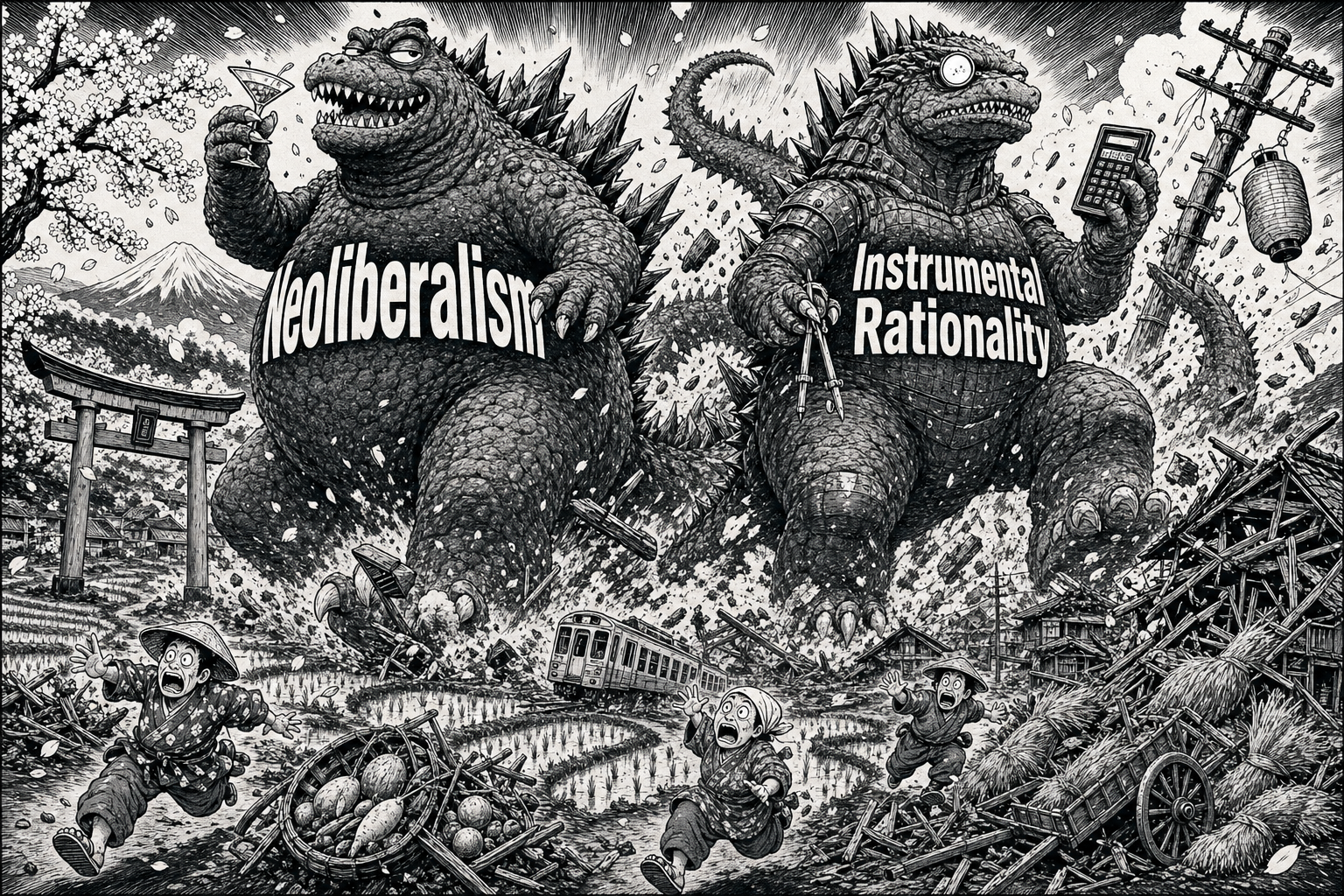
Approaches like intellectual and cultural history, like your research on anti-monopoly thinking, or Laura Phillips Sawyer's examinations of the evolution of legal doctrine, or Scott Sandage's laments for losers, or Alexia Yates's stuff on cultures of 19th century French real estate and cheese futures, or Sarvnaz Lotfi's work on how corporations accounted for R&D, and so many other examples, can be perfectly compatible with materialism. But we need to emphasize the phrase can be. A lot of intellectual history and recent approaches relying on "discourse analysis," sadly including loads of stuff on "neoliberalism," float free of material considerations, leading to what I jokingly call Critical -ism Studies, a form of idealism that acts as if ideas are causes that move around under their own power, spawning all kinds of havoc. And obviously the critique of "instrumental reason" we have seen above is just that kind of thing, and maybe it is even one of the key ur-versions of this intellectual move, as Cicerchia might suggest. Materialist intellectual and cultural history will always closely attend to how the people it is studying a) react to perceived realities and changes in the world around them and b) work to move those realities towards their goals. That is, they will focus on how people do things with words to achieve ends in the material world.
One of the most beautiful things of all is how materialism opens up and goes hand in glove with empirical investigation. I noted above that CPTC has no strong works featuring excellent evidence, and we have seen how Spengler shot historical narratives from the hip in ways that were utterly uninterested in showing they were true. Fans like to point out that Jacques Ellul wrote more than 60 books and 1000 articles, but by closely attending to his most famous volume, The Technological Society, you can see he read hardly anything, which, of course, is why he was able to write so much. Historical narratives, which were really simple morality tales he already believed before he started writing, fell from Ellul's ass without passing through any real thinking or investigation. This same lack of research and evidence-free historical storytelling also marks the works of Neil Postman and Langdon Winner.
But I believe we see the kinds of false intellectual moves and flagrant misuses of evidence common in CPTC most concisely in David Noble's book, The Religion of Technology: The Divinity of Man and the Spirit of Invention (1997). Noble was an interesting character. Just as some musical acts do their finest work in their initial record and then permanently decline, Noble's best book was his first one, America By Design: Science, Technology, and the Rise of Corporate Capitalism. America by Design certainly bore some imprints of Boomer New Left CPTC thinking, but it had many other upsides, including some interesting primary source research. But, then, for Noble . . . well, sadly, like a rolling stone, it was all downhill from there.
By the time he wrote, The Religion of Technology, Noble had ceased being a Marxist in any real discernible sense and had become a thoroughgoing cultural pessimist, which is why the book is so beloved by CPTC thinkers today like Mike Sacasas. In part one of the book, Noble argues that Western faith in technology stems from, well, actual religious faith, in the form of Christian millenarianism. He gives a potted history to support this idea.
Then in the second part, Noble examines grand claims made about the salvational potentials of technology in what we might think of as a set of areas of high-technology, capital-intensive areas of development often involving heavy state investment: atomic weapons, space exploration, artificial intelligence, and genetic engineering. As we know, including from recent works in hype and bubble studies, these spaces of cutting-edge technological and scientific development are precisely where you are most likely to find people, especially the kinds of leaders Noble liked to quote, making claims full of that delicious hyperbole we call hype, both because they may be true believers psychically-invested in the science fictional potentials of their life's work and because they are literally invested, financially and/or in terms of reputation and social position, in their undertakings, and they have to sell that shit. These kinds of people are highly incentivized, structurally-so, to blow hot air.
But in his conclusion to The Religion of Technology, Noble pulls what's an obvious sleight of hand, if you think about the relationship between claim and evidence for even half a second, which most fans clearly don't. Noble has shown readers that leaders in bubbly areas of high-technology spout hype, often with a religious valence. But he claims something much bigger when he writes,
"But it is not the practitioners alone who are so moved. A thousand years in the making, the religion of technology has become the common enchantment, not only of the designers of technology but also of those caught up in, and undone by, their godly designs. The expectation of ultimate salvation through technology, whatever the immediate human and social costs, has become the unspoken orthodoxy."
He goes on to call this supposed religion the "popular faith." But Noble clearly isn't entitled to these generalizations about the society he lives in. CLEARLY. Nowhere does he do the forms of work necessary to demonstrate that socially-incentivized hype coming out of the mouths of scientists, engineers, technologists, politicians, and business leaders is broadly representative of what other, larger populations - e.g., the people on the street - think. Noble could have done various kinds of work, such as asking other human beings what they thought, to substantiate his claim, but he didn't care to. Or maybe he thought he just knew what everyone around him was thinking (I have met people like that), and so instead of asking others questions with genuine curiosity about what he might find, he judged them. Put another way, it could be that Noble's thesis in The Religion of Technology and the generalizations he wants to draw from it are true and could be supported with evidence. It's just that he was so full of sloth he didn't bother to try.
There is a kind of fundamental laziness to CPTC, which, as we have seen, seems to mostly be the domain of well-educated white guys who don't like to work and look down on others who do work.
I will not out the scholar behind the anonymous CPTC Doomer Twitter account, Librarianshipwreck, but it's notable that all of his CPTC thoughts (as opposed to his actual published research) are vented as tweets and never developed into a serious, rigorous publications where the ideas would have to be spelled out at length and in depth and defended with evidence. And that's, apparently, because it's all fuckin' vibes.
When I think and talk about what materialist analysis looks like when it is done well, I often turn to the work of activist, writer, and MacArthur Prize winner Catherine Coleman Flowers. In her book, Waste: One Woman's Fight Against America's Dirty Secret and subsequent work, Flowers has shown how poor, mostly Black, people in rural Alabama and many other parts of the country lack access to sewers, septic tanks, or any other modern sanitation systems. As a result, people there regularly come into contact with raw human waste, and among other things, have begun to experience the reemergence of so-called tropical diseases, which can have devastating health effects and which had previously almost completely disappeared from the United States. The geology and soil in the county Flowers is from make septic systems expensive, sometimes more than $50k, and many people there are simply too poor to afford that.
Or we could think about why Black women in the United States are so much more likely to die during pregnancy and childbirth than white ones. Several factors contribute to this horrific reality, but apparently one of them is that Black women are more likely to be suffering from chronic diseases, including cardiovascular disease, when they become pregnant. And we all know how race is tied to class in this nation, and how those who struggle financially are more likely to experience chronic diseases because of their worries and their uncertainties and their never-ending stress and their diets and their lack of free time and leisure activities, like exercise, and the fraught course of their daily lives.
Or we could think about the housing crises throughout this country that force people into homelessness or lead them to live in buildings that are dangerous and unhealthy. Through my work on the history and sociology of maintenance and repair, I've become connected to community organizations that try to help people make their dwellings livable here where I live in Appalachia. Some of these groups organize around the concept of "critical home repair," which involves grave problems that arise and threaten to make a home uninhabitable, things like failing roofs, collapsing floors, broken heaters, burst pipes, dead well pumps, and electrical systems that shock and inflame. Lots of these people are what's called house, or mortgage, poor. They own their home, but that's about it. Why don't they fix these things? Well, folks, it's because they can't afford to.
We could think about any of these problems and more, and I could take you for a drive down my sublimely-gorgeous, winding valley road to mobile homes and old houses that are full of mold, with leaking roofs that threaten to cave in, and I could turn to you and ask, "Tell me why I need the concept of 'instrumental rationality' or this moralistic conception of 'technology' to explain what we see here and the suffering of the world."
Give me a fucking break.
(For the founders of the new publication outlet, The Journal of Critical What Sam Altman Ate for Breakfast Studies, and others who obsess over the utterances of Silicon Valley-style "Tech" elites, I might also ask how their work contributes to our understanding of such problems. Some of it indeed does, but the magnetic pull digital industries have on our attentions sidetracks us as often as, maybe even more often than it informs. Dawn Nafus nicely showed in her recent piece, "What Happens When AI Lives Rent-Free in Our Heads," that, last year, nearly 1/4 of papers at the STS conference 4S were on AI. We have a hype-chasing problem.)
No, when we examine real problems, real suffering in the world and ask about causes, we will find interests, won't we? People could afford to fix their homes if they made more money, but business leaders and groups - what we call business interests, including the trade associations Bentley and Truman wrote about so beautifully - fight wage hikes and unionization efforts. We could have a much more robust social safety net so that poor people aren't so stressed out all the time, but the well-to-do war against taxes. We could build a bunch more affordable housing, but entrenched local interests, NYMBYs, organize against it, which is not remotely surprising given how the home has become most families' primary asset; people are afraid. We could have meaningful climate policy, but it threatens the interests not only of giant corporations but also of land owners who might be displaced by new transmission lines and, even more, of we lowly consumers who don't want to see prices rise or our daily habits, the very stuff or our culture, change.
And, again, where does "instrumental rationality" fit in any of this? Indeed, if we were to go build a bunch of homes or septic systems or transmission lines for a green electricity grid or extend the social safety net, we would be using instrumental reason like a mothafucka, would we not?
Our politics of purity and the accusation of idolatry of "technology" are a sick, narcissistic, self-aggrandizing distraction. We should be ashamed of ourselves. (Though to offer a bit of compassion to the other side, in my experience, CPTC writers are typically deeply unhappy, unwell, neurotic, even mentally ill people who are so consumed by their own pain, including the volcanic emotional eruptions they experience when they consume media, that they aren't that curious and really don't care that much about the suffering of others. May they be safe. May they be happy. May they be healthy. May they live with ease.)
Another beautiful thing is that materialist analysis is able to describe and account for specific forms of decline, like how plant and factory closures cause economic devastation, depopulation, and even sickness in their regions. But materialist analysis is free of the illness of nostalgia. There was no Golden Age. If there was, look back in time and clearly describe where and when it was for me. It's like dudes who obsess over how some early 19th century elite, like Thomas Jefferson, had a longer attention span because, lucky for him, he didn't have social media yet, but fail to note or take interest in how Jefferson was a slave owner who also used his attention to manage plantations. Black people and many, many other folks will tell you how our visions of halcyon days of yore are dangerous, indeed harmful, myths.
Moreover, many materialist thinkers simply are more optimistic about the future because they know and can show that human societies have made many kinds of progress over the course of recorded history, and that sometimes humans have rearranged the material world in ways that contribute to such improvements, which is why the United States apparently hasn't experienced a cholera outbreak since the 19th century; why lifespans have increased; why infant and maternal mortality have (overall) declined; why we have access to greater comfort through inventions like anesthetics and HVAC; why we have vastly decreased some kinds of pollution; and so on and so forth. This is why I like to hang out with and learn from friends, like, I don't know, Aaron Benanav and Erica Robles-Anderson, who are optimistic and invested in making a better future.
And morning and night, I pray to the Goddess words like these: Oh, You who are everything, may Europe decide that livably cool air is a human right; may leaders and elites of those nations work especially hard to extend modern cooling systems to those in need, the least among them; and may they give up their bizarre superstitious beliefs about the relationship between health and conditioned air, which, if we are being real, probably go back to some weird shit, like late-19th and early-20th century theories about the spirit world.
I have never been an innovator. Everything in this essay is an extension of what I have learned from my scholarly communities, most of all the Society for the History of Technology and the Business History Conference, and from my friends and mentors, including you, Richard. I am proud of these traditions, which course like light through my energy-body, my heart-mind.
Much of what I've written above grew out of my work with The Maintainers community and the thinking I did for the book I wrote with Andy Russell, The Innovation Delusion: How Our Obsession with the New Has Disrupted the Work That Matters Most. It was while working on that book that Andy and I were first contacted by Stephanie Hoopes, the National Director of United Way's research group, United for ALICE. Hoopes and her team have created an alternative measure of economic hardship that works at the household level (because the federal poverty line is so low, bad, and un-insightful, as has been known basically since it was created). The ALICE crew routinely finds that about 40% of American households struggle to make ends meet.
When I learned of this sad reality - nearly half the country floundering! - a great ah ha washed over me. I'm a basic bitch in this sense: I really believe that poverty and environmental degradation are the greatest problems on our planet. And so, largely as a tribute to Hoopes and the ALICE team and the amazing work they do, I decided to write a book that has the working title, A Good History of Shit Jobs: When, Why, and How the American Economy Left So Many Workers Behind, a history of US society since the 1970s focused on why so many American individuals and families scramble to live, let alone be happy, healthy, and at peace.
And, now, having finished this goddamn essay that's haunted my soul for just years, it is time to write that book.
Thank you for all you have taught and given me, Richard. As I've said, many of the things I outlined above I look forward to exploring with my friends, including you. I can't wait for our next Zoom chat.
Lots of love,
Lee